


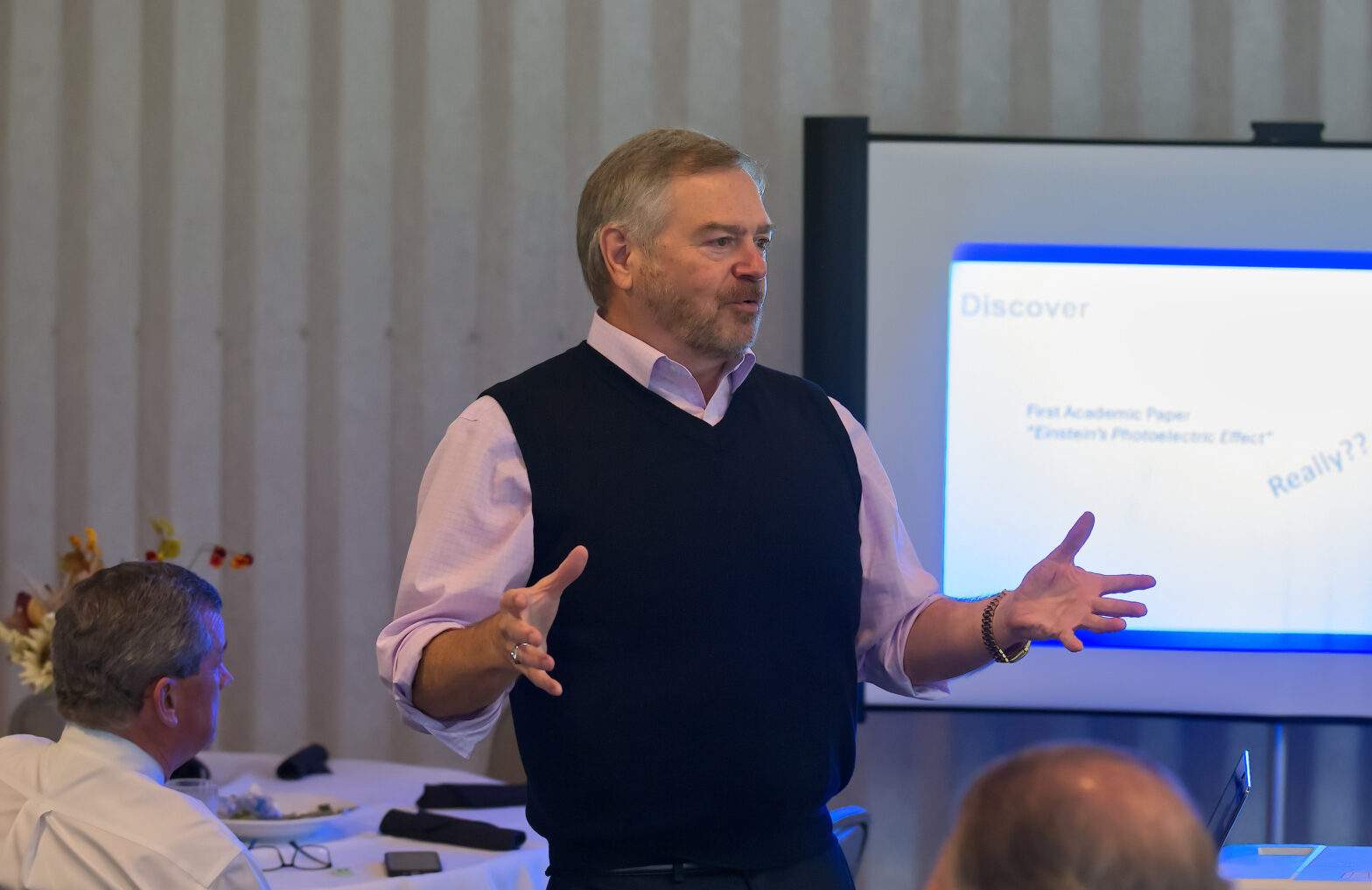
An Op-Ed by Ken Russell, Ph.D., Dean of the School of Business and Innovation at Barton College
When I was at Cisco, there used to be a saying: “It’s all about connections.”
Of course, for a company that was key to the development of the Internet, it was a bit of a tongue-in-cheek way to convey Cisco’s role in, well, everything! But for many of us, the “connections” part of that rang true. In life and in your career, it’s often the connections you make that help you grow, achieve, network, and transition from wherever you are, to whatever is next.
Getting ready for whatever is next is especially valuable now as organizations accelerate their use of Artificial Intelligence—notably generative AI technologies and applications.
Our research at Barton College reveals most companies lack the necessary in-house AI skills to advance beyond experimentation and discovery. Three years into what is being referred to as the “GenAI era”—marked by an increased awareness of AI with the public introduction of ChatGPT in November 2022—great strides have been made to install and implement AI into our lives.
But many of us have yet to go beyond merely initiating a prompt within Claude, ChatGPT, CoPilot, Gemini, or the seemingly dozens of AI tools out there. What is keeping us from exploring more, and integrating AI into our everyday routine?
The short answer seems to be upskilling and reskilling to meet the demands of an increasingly augmented and automated work environment. This requires time and effort to learn new tools and processes designed to reduce busy work (or so we hope) and to adopt techniques that help us rethink our work.
At Barton, we are indeed focused on closing the GenAI skills gap and cultivating a high-performance culture in the age of accelerated innovation. Yet, it’s not just upskilling (enhancing existing skills) or even reskilling (learning—or relearning—something to apply in new ways) that will be the real challenge.
The greater challenge is knowing how to integrate existing abilities across new contexts and AI-enabled roles, a skill most of us have yet to fully develop. To address this, we are encouraging our students, alumni, and colleagues to lean into rediscovering latent skills. Check that: not just latent skills, but the full spectrum of skills that make an individual unique and irreplaceable; capabilities learned over a lifetime that you can (and should) apply to your efforts with AI.
As an example, abilities learned in one role, such as Business Analyst or Retail Sales Associate, can be applied to AI-enabled positions like AI Auditor, Ethics/Human-in-the-Loop Specialist, or even Data Scientist. Yep. And this isn’t just for high-profile jobs—those minimum-wage days spent making cheeseburgers (process flow, assembly) and handling disgruntled customers (empathy, problem-solving, critical thinking) built competencies that are exactly what today’s and tomorrow’s jobs require.
Let that last bit sink in.
Developing and fostering engaged critical thinkers is what we do at Barton. Our graduates ask why, consider how, and explore questions of intent and impact, all essential components of a Liberal Arts education. Preparing students and our broader community for an AI-driven future means providing up-to-date curricula, practical skills training, meaningful connections, and the tools to remain lifelong, engaged critical thinkers.
Remember: it’s all about connections, and to help, I’ll offer a quick learning mnemonic:
C-Accept the Challenges ahead of you
O-Take advantages of the Opportunities you discover
N-Network and meet new people, friends, and colleagues
N-Navigate those new relationships and display your skills as an
E-Engaged
C-Critical
T- Thinker!
Yes, new skills will always be required for lifelong learners but try to remember the other (often distant) skills you’ve accumulated along the way and take time to demonstrate your uniqueness and importance by tapping into ALL your skills to ensure you’ll thrive in our new GenAI-enabled world.